
Has New Zealand’s strategic environment undergone a fundamental change?
Are New Zealand’s existing strategic relationships still fit for purpose? Wayne Mapp explores whether a relationship rethink is necessary.
There is a great deal of anxious speculation about the prospects of a dramatic change to New Zealand’s strategic environment. Much of the discussion revolves around the proposition that the American century is drawing to a close. Consequently, New Zealand’s security arrangements are seen by some as no longer viable.
It is certainly true that the United States, especially under President Trump, is retreating from Europe. Even the war against Iran has the air of finality for the United States’ incursions in the Middle East, uncomfortably recalling the end of Anglo-French dominance in the Middle East following the Suez debacle of 1956.
While President Trump may be more caustic in his attitude toward Europe than previous presidents, there can be little doubt he is only reinforcing a long-term reduction of United States commitments to Europe. Well over a decade ago, President Obama was signaling a pivot toward the Asia Pacific.
New Zealand and Australia have been severely hurt by the closure of the Hormuz Straits. However, unlike Europe, the war has not led to a fundamental reappraisal of the role of the United States in the Asia Pacific.
“Has the strategic environment changed to the extent that New Zealand should consider a wider range of strategic partnerships? This question can be answered in the affirmative. “
There are several New Zealand commentators, primarily from the Left, who would prefer a different outcome: that the mercurial nature of the Trump administration should result in New Zealand substantially withdrawing from the hitherto close relationship with the United States. This is an unlikely scenario. The United States is too deeply intertwined within the Pacific to weaken its links with Australia, and by implication, with New Zealand.
It is worth restating the reasons why the United States is withdrawing from Europe and building up in the Asia Pacific. The principal reasons are the weakening of Russia and the continuing rise of China.
Although Russia has a powerful legacy nuclear deterrent, in most other respects Russia is a declining power. Russia’s population of 145 million continues to shrink. The Russian economy is progressively de-industrialsing and increasingly dependent on the export of basic raw materials such as crude oil.
In contrast, China has a population of 1.4 billion, literally ten times greater than that of Russia. China has the world’s second largest economy, and perhaps more significantly, is by a considerable margin the largest exporter of manufactured goods. For the United States, China, not Russia, is seen as its greatest competitor. For many in the United States, the perception is that China is not just a competitor, it is the United States’ principal adversary.
Since China is an Asia Pacific power, naturally the United States will increasingly focus on the Asia Pacific. However, the pivot is not just a reflection of current great power competition.
The United States has sovereign territory right across the Pacific. The connection is much deeper than merely having the West Coast bordering the Pacific. There is the state of Hawaii, the territories of Guam, Midway, Wake, and in the South Pacific, American Samoa, all deep within the Pacific. In addition, there are numerous atolls and islets plus associated territories. There are no such analogies in the Atlantic. The United States is vested in the Pacific in a way that it is not in the Atlantic.
Virtually all United States territories in the Pacific are located north of the equator. But as relatively small islands, they are vulnerable, as was shown in World War Two. Australia serves as the bulwark of protection. The defeat of Japan was heavily dependent on Australia being the key base to mount the stepping-stone invasions of the island territories that had been conquered by Japan.
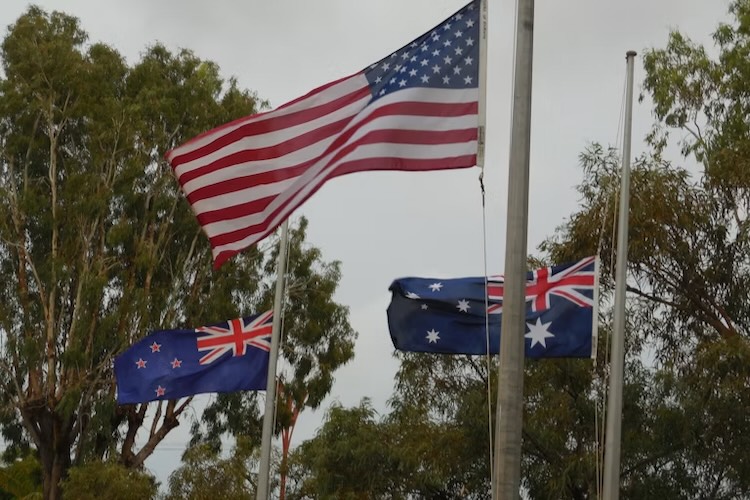
This fundamental geographic strategy remains as imperative today as it did over 80 years ago. The United States alliance with Australia is the cornerstone of United States strategy in the Asia Pacific. For both Australia and the United States, the ANZUS alliance is indispensable.
The United States role can be contrasted with that of China. Although China is the most important trading partner for both Australia and New Zealand, China could not serve as a guarantor of Australian and New Zealand sovereignty. There is no strategic imperative or interest, whether by China or Australia and New Zealand, to build such a strategic alliance.
Instead, the interest of both Australia and New Zealand is to ensure that the great power rivalry between China and the United States remains within the bounds of international law.
ANZUS continues to lock New Zealand in. It was noteworthy that Prime Minister Luxon referred to ANZUS as the basis of Australia being New Zealand’s only formal ally, though the ANZAC relationship is much deeper and has much older antecedents than an agreement from 1951. It is unthinkable that New Zealand would leave the Australia New Zealand alliance, though different New Zealand governments may give the alliance varying levels of attention.
ANZUS is, of course, a trilateral agreement. It links New Zealand to Australia, and it links Australia to the United States. Since 1987, ANZUS no longer links New Zealand and the United States. But this is a matter of convention.
Notwithstanding New Zealand’s nuclear free status, New Zealand has never formally withdrawn from ANZUS. Instead, the United States suspended its alliance obligations toward New Zealand due to New Zealand no longer allowing United States nuclear powered or nuclear armed vessels to enter New Zealand ports. The ANZUS agreement remains and could be fully reactivated if the parties, in particular the United States chose to do so, irrespective of New Zealand’s nuclear free policy.
The relevance of ANZUS is that it embodies a set of alliance relationships that still, albeit in differing ways for each of the parties, sets the strategic relationship between them. These relationships are so deep that it not foreseeable that any of the three nations would establish a new set of strategic security relationships that would fundamentally disable the ANZUS relationships.
Strategic relationships are not fundamentally about the formal agreements that establish them. Rather the agreements reflect relationships of long-standing mutual advantage backed by tangible power. In this sense, ANZUS remains a bedrock agreement within the Pacific.
The reasons for ANZUS, stemming back to World War Two, remain extant. Australia still sees the United States as the guarantor of its sovereignty. The United States still sees Australia as the bulwark protecting its territories across the Pacific. New Zealand remains enmeshed with both Australia and the United States. There are no other alternative security relationships for any of the three states that could replace ANZUS.
However, being within a set of security relationships does not mean that any of the three states lose all agency. Each of them has their own perspective of the world and how they interact with other states. Australia and New Zealand are not vassal states of the United States.
Nevertheless, the depth and importance of each of the relationships does affect how each state conducts itself. For instance, Australia, as a formal ally of the United States, felt it necessary to express a level of support for the initial United States attacks on Iran, specifically with respect to Iran not developing nuclear weapons. New Zealand, which is no longer regarded as a formal ally of the United States, did not see it as necessary to provide such statements of support.
The question posed at the outset was whether New Zealand’s strategic environment has fundamentally changed. The answer is no, at least not to the extent that New Zealand could contemplate changing its core strategic partners.
There is, however, a lesser question. Has the strategic environment changed to the extent that New Zealand should consider a wider range of strategic partnerships? This question can be answered in the affirmative.
New Zealand’s longest standing defence relationships are with Commonwealth nations. The Five Power Defence Arrangement involves Australia, Malaysia, New Zealand, Singapore and the UK. New Zealand’s Canadian connections extend back to World War One. However, New Zealand has made little of other opportunities with other Commonwealth nations, India being notable in this regard. With the conclusion of the Indian free trade agreement there is the opportunity to build on that in the defence and security arena. Australia and India are deepening their links given they are the major states bordering the Indian Ocean. New Zealand should actively broaden its defence and security links, especially given the growing importance of India.


