
New Zealand Army’s Missing Battalion
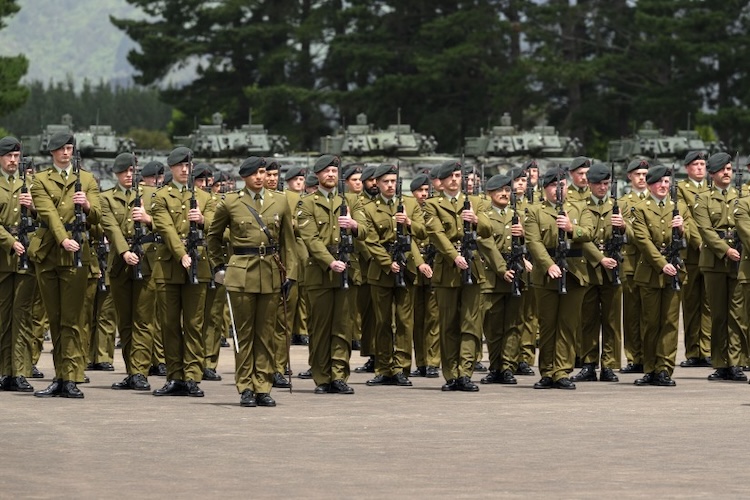
A third battalion would create a three-battalion framework resolving the inherent fragility of the existing two-battalion structure, writes Graeme Doull.
There is a perception within the Army that New Zealand has too many Brigadiers for a force of its size. To some observers, 13 Brigadiers in an Army comprised of just a brigade’s worth of soldiers appears difficult to justify. Personnel data obtained under the Official Information Act suggests a wider problem.
Benchmarking against a typical NATO force structure, the biggest imbalance in the New Zealand Army sits within the middle and upper layers of the organisation: a substantially larger proportion of Senior Officers and Senior Non-Commissioned Officers (SNCO) than would typically be expected.
There is an argument that a small army requires proportionally more personnel in staff and headquarters roles. Staff roles are typically filled by Captains and Majors at the operational level, and Lieutenant Colonels and Colonels at the strategic level.

Even allowing for this, the current structure is difficult to defend. The Army now has almost as many Colonels as Lieutenants. This raises legitimate questions in relation to organisational design and long-term resilience.
The SNCO structure is perhaps even more striking. The New Zealand Army has 302 Warrant Officers, equating to roughly one Warrant Officer for every four to five private soldiers. By comparison, an infantry battalion of around 600 personnel would typically contain only seven to nine Warrant Officers.
While additional Warrant Officers are required across headquarters, schools and specialist units, this number of senior soldiers appears excessive.
New Zealand has a small army and cannot realistically sustain every function maintained by larger militaries. A contributor to this overhead is the decision to retain independent doctrine, procurement, and training systems.
“The structural ‘surplus’ of 546 Senior Officers and SNCOs, if repurposed, represents sufficient budgetary and personnel headroom to generate an entire additional battalion-sized manoeuvre unit. “
There is a strong argument for systematically aligning with Australian Army doctrine, standards and processes wherever practical. Reducing unnecessary duplication would free resources for front-line roles, and alignment would improve interoperability with our closest ally.
The wider public sector is under pressure to focus on front-line delivery rather than administrative support. Defence must be no exception.
The structural ‘surplus’ of 546 Senior Officers and SNCOs, if repurposed, represents sufficient budgetary and personnel headroom to generate an entire additional battalion-sized manoeuvre unit. This could also free up resources to help address rates of pay for more junior service personnel.
A third battalion would create a three-battalion framework that would resolve the inherent fragility of the current two-battalion structure, providing vital operational depth and sustainability.
This would allow for one battalion deployed, one preparing for deployment, and one regenerating capability. This rotational model would enable sustained operations and reduce pressure on personnel. It would also create an opportunity to establish a permanent land force component in the upper North Island.
Whangārei is a logical choice for an upper North Island battalion. It offers close proximity to Auckland – the country’s economic and demographic centre of mass – without the accompanying cost-of-living challenges, while providing ready access to a deep-water port and a high quality of life. This would support recruitment and retention while enhancing national resilience.
Change like this requires political leadership – an internal Defence or Army review cannot navigate this opportunity.
Organisational theory suggests large institutions rarely choose reforms that reduce their own headquarters or senior management structures. Put crudely: turkeys don’t vote for Christmas. If the Government wants a resilient combat force rather than a top-heavy bureaucracy, the Minister of Defence must explicitly mandate change from above.
Defence spending is about trade-offs. Decisions should be framed around future needs, not the status quo. In this case, the Government needs to ask: does New Zealand’s security benefit more from an oversized headquarters, or would a third battalion in the upper North Island be a better investment?


